I keep every agent accountable.
- Describe
- Govern
- Deploy
Describe the job.
Bob drafts the governed agent.
Pattern, tools, limits, approval gates, each picked from your own words with one line saying why. You confirm or change. Then download a signed package any runtime can verify with one command.
See how it worksNo credit card required. Build your first governance package in minutes.
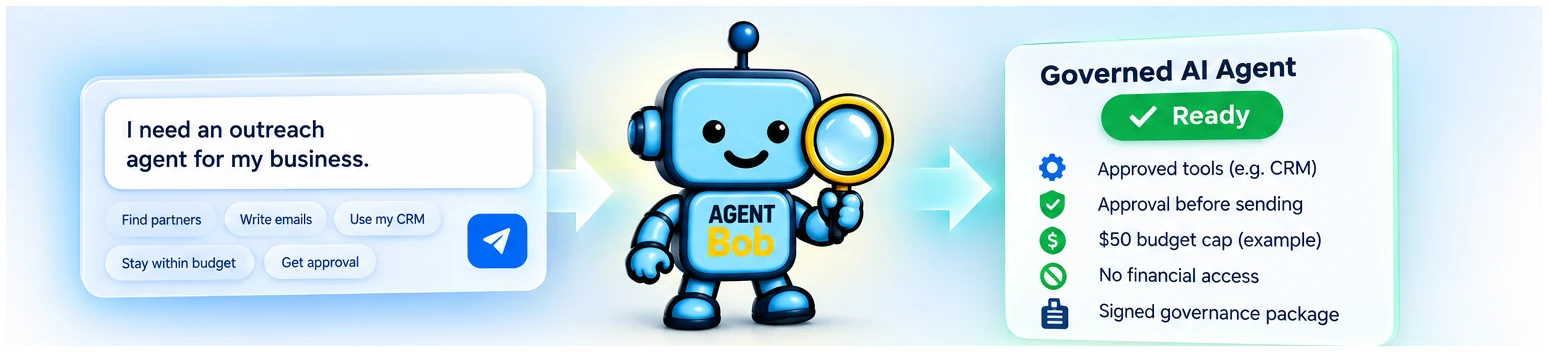
“I need an outreach agent for my business.”

- CRM access, read and write
- Draft for approval before sending
- $50 monthly budget cap
- No payments access
- Signed governance package
Example draft. You confirm or change every line before you download.
The problem
The industry is racing to make agents more autonomous and more capable. Almost no one is making them accountable. The result: agents that act in ways you didn't intend, say things you never approved, and leave you no way to prove what happened. Capability without governance isn't an asset. It's exposure.
You describe the job.
Bob drafts the governance.
Seven panels: purpose, personality, tools, autonomy, budget, memory, approvals. Bob fills each one from your description and writes a line saying why. Nothing is locked. Change any pick before you download.
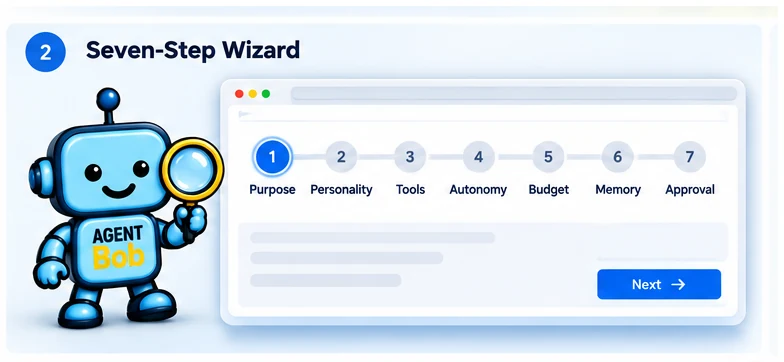
- 1Purpose
- 2Personality
- 3Tools
- 4Autonomy
- 5Budget
- 6Memory
- 7Approvals
“You describe the job. I’ll draft the rest.”
Why governance matters
An AI agent is easy to build. Knowing what it's allowed to do is harder.
Without governance
- Unknown tool access
- Unclear autonomy
- No spending limit
- No approval gates
- No signed policy
With Agent Bob
- Approved tools, and nothing else
- Defined autonomy level
- Budget limits written down
- Human approvals named
- Signed policy
- A package anyone can verify
What Agent Bob does
Agent Bob is the layer the agent platforms skip. You describe the job in your own words. Bob drafts every setting, seals the result in a governance package, and writes the brief your runtime needs to enforce it.
What you get
Bob drafts every step
Pattern, tools, autonomy, budget, memory and approval gates, each one picked from your description with one line saying why. You confirm or change any of it.
A signed package
The signature covers the exact bytes of policy.json, so anyone can check it with sha256sum and confirm which governed version is in play.
HANDOFF.md
A per-agent brief for Hermes, OpenClaw, n8n, or a developer, plus a list of what you will still need to provide.
Why it's different
The missing layer
Other platforms optimize autonomy and capability. Agent Bob adds the part they leave out: governance you can verify.
Bound to the package, not the prompt
Your rules are not polite suggestions buried in a prompt. They are compiled into a signed package, and HANDOFF.md tells your runtime exactly what to enforce.
Verifiable, not vibes
A cryptographic pin proves which governed version is in play. No 'trust us.'
Works alongside your stack
Keep building agents however you like. Agent Bob governs the ones that face customers, partners, or the public.
Who it's for
Any agent whose mistakes would cost you.
Customer support
Keep answers inside policy.
Operations & internal tools
Bound what an agent can touch and claim.
Research & analysis
Require sources, prevent confident fabrication.
A signed agent package
you can take with you.
Eight files, written for your agent. A complete governance specification, not a running agent. Your runtime implements it; the files do not enforce themselves.
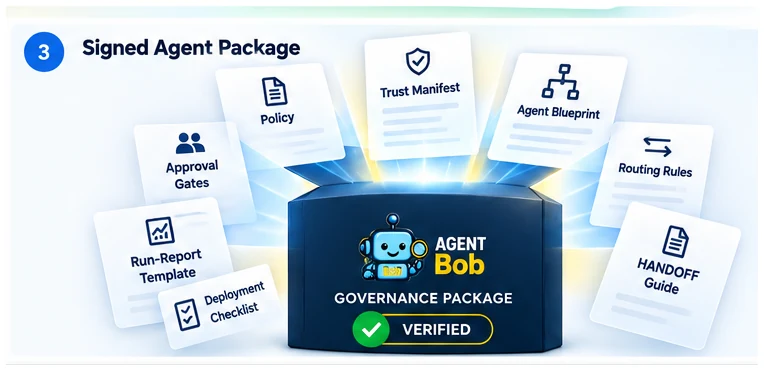
policy.json
The rules and limits for the agent.
trust-manifest.json
Governance summary, signature and policy hash.
agent-blueprint.json
What the agent is supposed to do.
routing.rules.json
Which tools require approval.
HANDOFF.md
How to hand the package to a runtime and make it enforce.
approval-gates.md
The human approval rules.
run-report-template.json
How agent activity should be logged.
deployment-checklist.md
What to check before going live.
trust-manifest.json carries a SHA-256 digest of the exact bytes of policy.json and is HMAC-signed, so a later edit to your limits is detectable.
unzip -p your-agent.zip policy.json | sha256sumCompare the result with policy_sha256 in the manifest.
The approved rules, claims, and identity definitions.
The rules your runtime applies so the agent stays inside that manifest.
A SHA-256 fingerprint that verifies the exact version running.
Turn on the n8n plan and you get a ninth file, n8n-workflow.json. It is a node-by-node build plan, not an importable workflow. The paid deploy download adds a README-deploy.pdf quickstart.
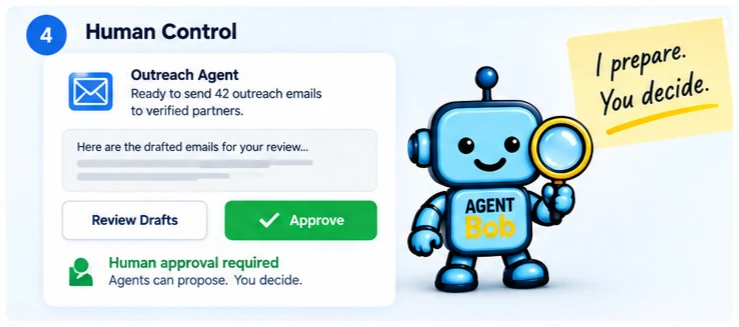
You stay in control.
Agents can propose. You decide. Every gate Bob writes into approval-gates.md is a mandatory pause for a human, none are advisory, and routing.rules.json names the tools that can't be used without one.
More autonomy shouldn't mean less control
Most AI agents loop until the budget runs out, or never stop at all. Agent Bob lets you set hard limits before your agent runs and signs them, so a change after the fact is detectable.
Hard bounds
Cap iterations, spend, and run time. Your runtime reads the caps from policy.json and stops there.
Stall detection
The policy tells your runtime to halt when the agent spins in circles, instead of burning the budget.
Human in the loop
When a limit is hit, the policy hands the decision to a person instead of letting the agent push on.
Tamper-evident
Your limits are signed into the agent's policy, so anyone can tell if they were loosened after the fact.
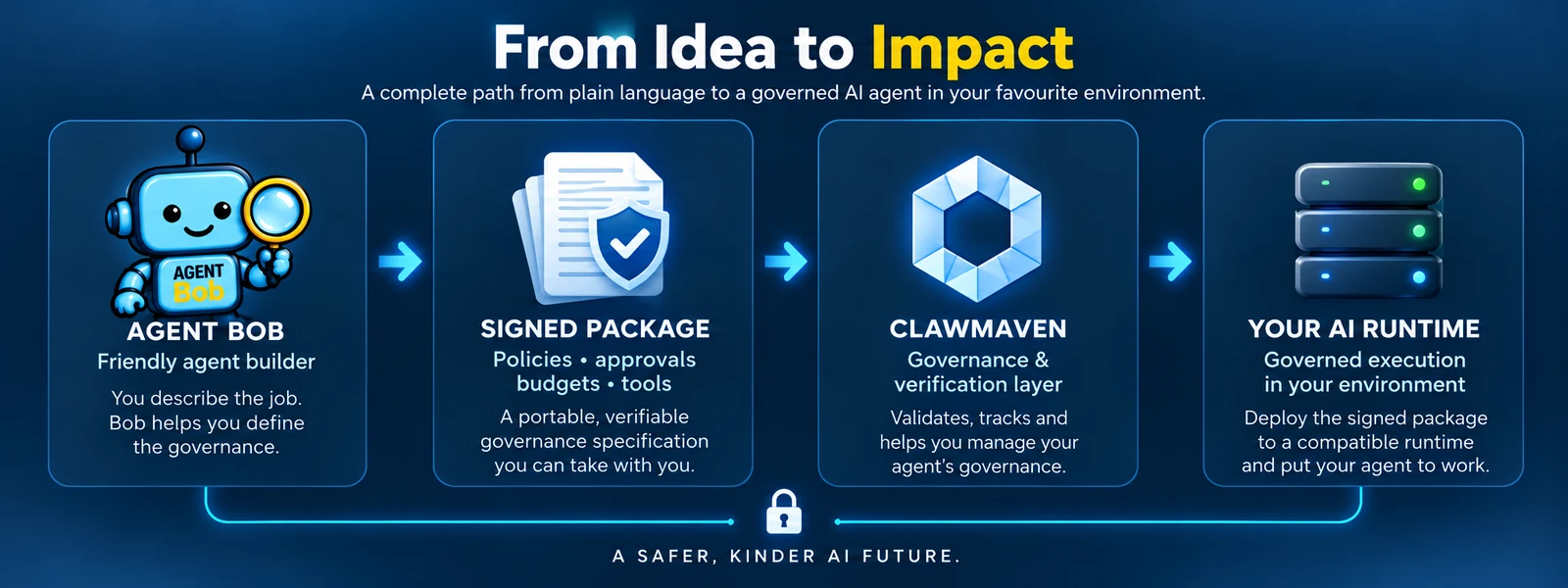
Agent Bob is the builder.
Your runtime is the enforcer.
Four layers, four jobs. Bob makes the governance accessible, ClawMaven verifies it, and the runtime you already use is where the agent actually operates.
Agent Bob
Friendly agent builder. Turns your description into a governance specification.
Signed package
Policies, approval gates, budgets and tool permissions, sealed and hashed.
ClawMaven
Governance and verification layer. Attests the package and posture in the manifest.
Your AI runtime
Hermes, OpenClaw, n8n or your own code. This is where the rules are enforced.
Portable. Verifiable. The package travels with you. The runtime is what makes it bind.
The suite
Agent Bob governs any agent: one function, many jobs. Sales Bob is the done-for-you sales vertical: one job, many products.
Both run on ClawMaven, the same governance standard.
Common questions
What is Agent Bob?
+
Agent Bob is a friendly onboarding tool that helps non-technical teams design a governed AI agent. You answer plain-language questions and Bob generates a deployment-ready governance package backed by ClawMaven governance.
What is a governed AI agent?
+
A governed AI agent is an AI agent that ships with explicit rules: which tools it can use, when a human must approve an action, how much it can spend, what data it can remember, and how its activity is logged. Agent Bob produces these rules as an eight-file governance package.
How do I govern an AI agent with Agent Bob?
+
You walk through a 7-step wizard: pick an industry and agent pattern, set personality and tone, choose tools, define autonomy and loop limits, set budget and usage caps, configure memory rules, and set approval gates. At the end, Bob compiles everything into a pinned governance package you can deploy.
What is loop governance and why does it matter?
+
Loop governance is Agent Bob's way of keeping an agent from running out of control. You set hard limits on iterations, run time, and spend. The signed policy tells your runtime to halt or escalate to a human when the agent stalls or hits a bound, instead of burning budget or making unchecked decisions.
Can Agent Bob stop an AI agent from running forever?
+
Agent Bob writes the bounds and your runtime enforces them. You set hard limits on iterations, run time, and spend, and the signed policy tells your runtime to stop the agent when it exceeds one. The agent does not stop by itself. You can also enable stall detection, which tells your runtime to halt when the agent stops making meaningful progress.
What is a tamper-evident policy for AI agents?
+
A tamper-evident policy means your limits and rules are cryptographically signed into the agent's governance package. If anyone tries to change them after the fact, the signature breaks and the mismatch is detectable. This makes agent behavior provable, not just promised.
What happens when an AI agent reaches its limit?
+
You choose the outcome in advance: halt stops the agent completely, while escalate hands the task to a human for review. Either way, your runtime stops it at the boundary you set.
What is in the governance package?
+
The package contains eight files: a handoff brief (HANDOFF.md), an agent blueprint, a policy file, a trust manifest, routing rules, a run-report template, an approval-gates document, and a deployment checklist. The 'Deploy this agent' option also includes a tailored README-deploy quickstart.
Capability is everywhere. Accountability is the edge.
Build a kinder
AI future.
It starts with the next agent you create.
Start with one agent. Prove what it will and won't do.